
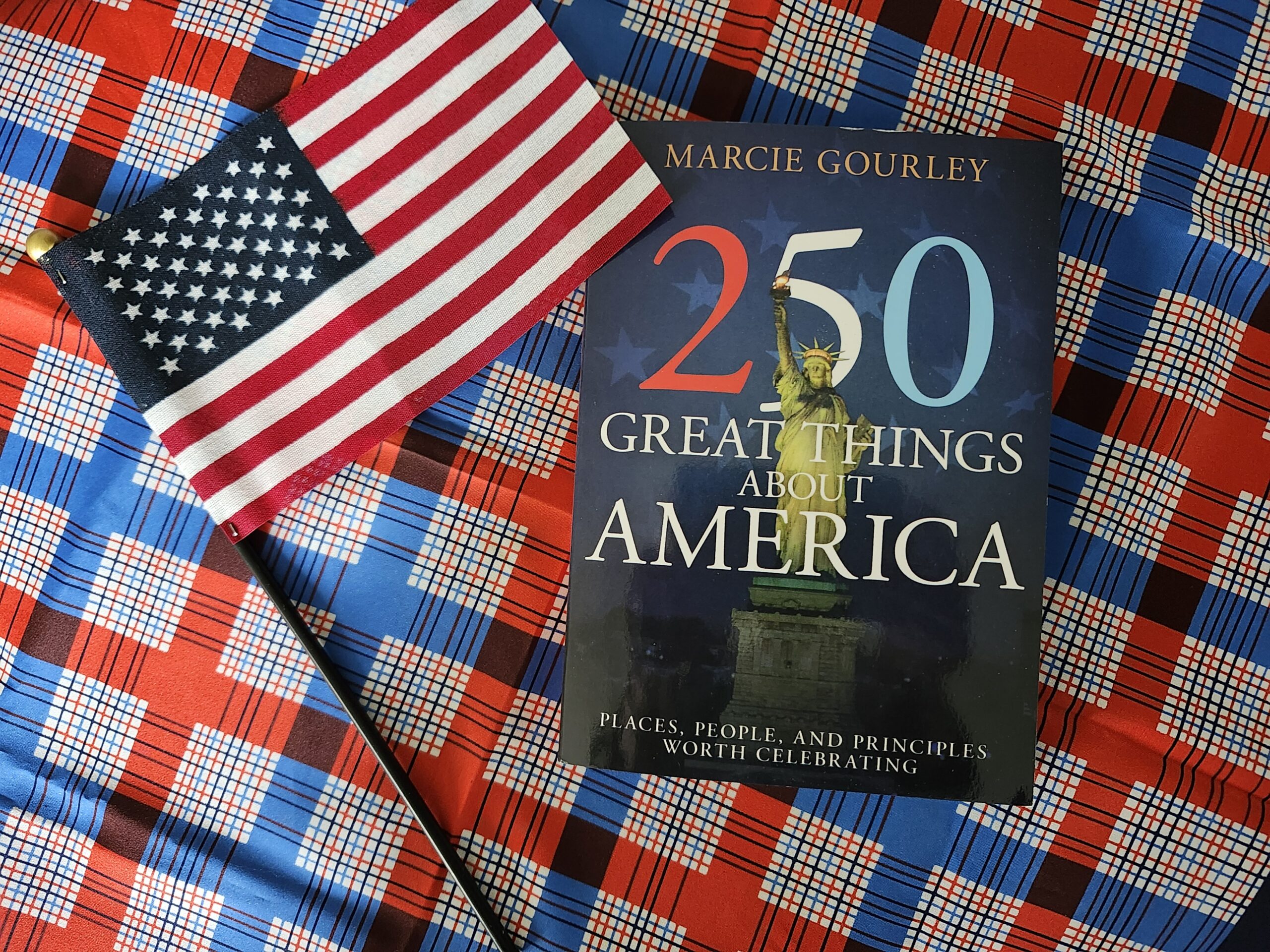
 I discovered a book by a gifted writer named Marcie Gourley that can help us savor 250 wonderful aspects of our beloved homeland—the United States of America. This 236-page book contains 250 short reflections that each have a single adjective as their title. I was already inspired just by reading the author’s introduction to the book.
The author of this book, Marcie Gourley, is a licensed professional counselor. Marcie has always had a heart for people and a great love for history, for America, and for faith. Marcie’s dad frequently took her and her sisters to locations of historical significance, to burial grounds, and to political happenings. Marcie has also been the coordinator of the Pennsylvania chapter of American Christian Fiction Writers. She is a wife and a mother of five adult children.
The reflections in this book focus on many facets of our country—people, places, events, challenges, accomplishments, music, and sports. This book will probably remind you of some of the things you learned in school but hadn’t thought about for a long time and teach you new, fascinating details you had never known before. You may read of places you would love to visit. Some reflections will probably touch you deeply. Some of the information piqued my interest and prompted me to search for further information on the internet. These reflections are roughly in chronological order, unfolding the development and events of the country.
I decided I would share the main points of a few of the reflections, to whet your appetite. I jotted down the identifying numbers of the reflections from which I would be especially anxious to share. To my chagrin, when I was finished jotting down those numbers I counted 35. That was way too many. Somehow I would have to disqualify some, though I felt they were all quite significant. Here are the ones I finally decided to highlight:
#33 – This reflection reminds us of the dedication and sacrifice of George Washington and the exhausted, barefoot army he led across the frozen Delaware River– as they fought to free our country. The snow revealed their bloody footprints.
#37 – This reflection speaks of the naming of the bald eagle as our national symbol by the Continental Congress. Would you believe Benjamin Franklin thought it should be the turkey? He objected to the eagle because eagles sometimes steal food from other kinds of birds.
#78 – This is the sweet story of the reason Abraham Lincoln grew a beard. It has to do with the request of an 11-year-old girl who wanted him to win the election.
#90 – This reflection tells of the woman who wrote the “Battle Hymn of the Republic” to the tune of “John Brown’s Body.” When Abraham Lincoln first heard it, he stood up in respect. It brought tears to his eyes.
#102 – This reflection revealed to me that the inventor of the telephone, Alexander Graham Bell, was a teacher of the deaf and married a deaf woman. His research into vibration helped his students.
#105 – I learned from this reflection that America was the first nation to set aside a large wilderness area for its citizens. Do you know which park was designated as our first national park in March, 1872?
#109 – This reflection tells of the huge engineering feat of the Brooklyn Bridge. To give citizens confidence in its strength, P. T. Barnum had 21 elephants and 17 camels cross the bridge.
#123 – This one revealed the surprising fact that air conditioning was devised by a man named Willis Carrier, to control the humidity for a paper company. It changed life in America.
#136 – We might assume that “The Star-Spangled Banner” was sung at games since the onset of the World Series. But this reflection explains that in 1918, when World War I had not yet ended [and the song was not yet the national anthem], during the seventh inning stretch a band played the song. Players stood still, soldiers saluted, and the crowd stood up. A reverent hush took place before the fans began to sing the lyrics. That began the tradition.
#180 – I could not overlook the reflection recounting a U. S. troop transport ship struck by a torpedo from a German U-boat in 1943. Four chaplains on board gave up their life jackets to save others. They sang hymns and prayed while standing arm in arm as the ship sank into the frigid waters.
#189 – This reflection explains that in 1948 the Soviet Union blocked supplies to West Berlin to gain control. American and British pilots flew back and forth to deliver basic foods. One U. S. pilot earned the nickname “Candy Bomber” for dropping chocolates and gum as treats for the children.
#249 – The author goes backward in history a ways in this reflection. She tells the story of a little boy named Israel Beilin, who fled Russian persecution to the U. S. in 1893. He would later become Irving Berlin. He served in the U. S. Army in World War I, during which he wrote music and lyrics for “God Bless America.” He didn’t reveal the song until war was once again on the horizon. “God Bless America” was introduced to the world by singer Kate Smith to honor Armistice Day [now called Veteran’s Day] in 1938.
If you want to go back in time and ponder the historic day when Americans heard Kate Smith introduce this well-known and well-loved song over the radio, click on the video below. This video clip was taken from a 1943 war-time musical movie called This Is the Army, wherein they captured what it must have been like when Americans scattered across the country had their radios on and heard the song for the very first time.



Thanks for sharing parts from 250 Great Things About America book. Plus God Bless America segment. All of it is helpful to remind us of our great country and those who used their talents and many that sacrificed their lives for others and for our country.
Hi Annelle, Thank you so much for reading and replying. Please feel free to also share with anyone else who might be interested. 🙂