

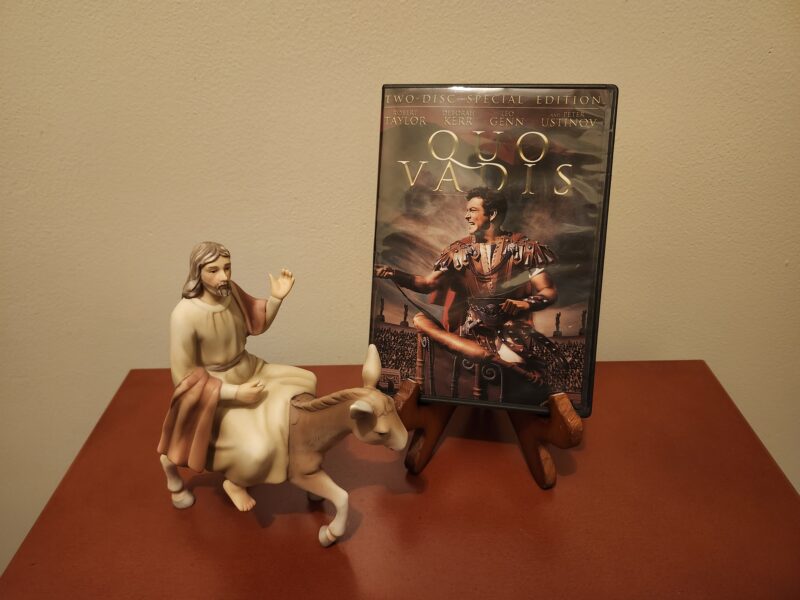
Quo Vadis is a movie you are not likely to forget as soon as the credits roll by. This movie won eight Oscar nominations, one of which was Best Picture. There were 110 speaking parts and a cast of 30,000. The costuming is quite impressive. Most importantly, it is a powerful story.
This 1951 movie called Quo Vadis opens with a procession of Roman soldiers returning to Rome—some on horseback and some on foot—followed by foes they had captured and enslaved. The story begins in 64 A.D., not long after Christ was crucified by Roman soldiers. Handsome and fit Robert Taylor plays Marcus Vinicius, a commander of the Roman army.
Early in the movie Commander Vinicius enters the palace of Roman Emperor Nero—a man of unsurpassed and nauseating arrogance. Nero is known to have had his own mother and first and second wives killed, among other persons. Peter Ustinov gives a very dramatic and believable portrayal of Nero.
Marcus Vinicius soon goes to visit the home of a wealthy retired general, Aulus Plautius. Marcus is immediately enamored of Plautius’ adopted daughter, Lygia (pronounced lid’-jee-uh), mistaking her at first for a house servant. Lygia, whose long, flowing, reddish hair allures Marcus, is played by Deborah Kerr. Lygia and her adoptive parents have had their hearts softened by allegiance to Christ and His ways. Lygia’s soft heart and Marcus’ confident spirit that enjoys conquest are at odds. The apostle Paul visits the home of the retired general.
Marcus is obsessed with breaking down the wall that Lygia has erected between them. He orders her to be taken to the palace and placed as a hostage with Nero’s women. Lygia of course is not pleased with this action and makes it clear to Marcus that she is eager to return to her home.
Roman Culture Vs Christianity
But this movie is not just a story of romance. It is also the story of the pagan Roman culture bent on conquest versus the Christians who wish to be loyal to Christ—regardless of the cost. An aged disciple of Jesus, the famous Simon Peter, appears in the story.
The movie breaks for intermission about 1-1/2 hours in, shortly after Marcus plays a board game on a palace porch with his uncle, Petronius, and then departs. The first part ends right after Petronius has a brief conversation with his lover and she then says, “Such as I feel cannot ever die.” At that point you may want to break for snacks or powder room visits or watch the second part later.
The movie continues for nearly another 1-1/2 hours, though it seems to go by quickly. I won’t divulge the plot and spoil it for you, but I will tell you that before the movie ends you will witness a portrayal of the historic burning of Rome. I must admit that I had never thought about how terrifying that experience must have been if the homes were in close proximity to each other. Thousands would have stampeded in the streets in panic. During this movie you will also witness a scene that will help you realize the great courage required by the Christians who were mercilessly martyred by the Romans. It might even remind you that still today Christians in many parts of the world are severely persecuted. This is not a movie for young children. Teens and some older children should be able to watch it.
Although the movie Quo Vadis is based upon abundant historical research of Rome in Nero’s time, it has been fictionalized. For instance, Marcus Vinicius and Lygia are fictional characters, and the source of the great fire of Rome has not been clearly established.
Concerning Parts
I only noticed three lines in the script of the movie that I would object to. The first is that a young boy prophesies to Simon Peter that Jesus said that, if Peter did not go to Rome to support the Christians there, Jesus Himself would go to Rome and would be crucified a second time. The purpose of Jesus dying on the cross was to pay, once and for all, for the sins of all who would repent and believe in Him. Romans 6:9 says, “. . .knowing that Christ, being raised from the dead, dies no more. Death no longer has dominion over him.” After He was raised from the dead, Jesus returned to His exalted position in Heaven as part of the Trinity to fulfill the important role of interceding for us, as the One who took our punishment for sin. Romans 8:34 tells us that Jesus is “at the right hand of God, who also makes intercession for us.” Jesus didn’t need to be physically present with the persecuted believers in Rome. When He left, the Holy Spirit came to indwell and help all believers. John 14:16-17 records these words of Jesus to His disciples: “I will pray to the Father, and he will give you another Counselor, that he may be with you forever, the Spirit of truth, whom the world can’t receive, for it doesn’t see him and doesn’t know him. You know him, for he lives with you and will be in you.” [Quotations from the World English Bible translation.]
The second line of the script I would object to is when Petronius says, “The Christians say that death is but a transition to a better life.” I think that what the Christians would have said is that “death is but a transition to a better life– if you repent and believe that Jesus is God’s Son and died to pay for your sins.” John 3:16 says, “For God so loved the world, that He gave His only begotten Son, that whosoever believeth in Him should not perish, but have everlasting life.” [King James Version]
My third objection is that there is a line that gives the impression that marriage is eternal. In Matthew 22:30 Jesus said, “For in the resurrection they neither marry nor are given in marriage, but are like God’s angels in heaven.” [World English Bible]
I will let you see for yourself where the relationship between Marcus and Lygia stands at the conclusion of the movie. The last few minutes of the movie contain quite a dramatic turn of events. Below is a trailer to let you sample portions of the movie.
YouTube – Quo Vadis (1951) Official Trailer (HD) Uploaded by Trailers Playground HD [5:11]


Leave A Comment