


Spring and early fall are the times people in many climates think about taking on painting and finishing projects. The weather is warm enough to open the windows for ventilation. On the other hand, the weather isn’t so hot that you will be sweltering while working with the windows open. Trust me. You don’t want to do that. I painted my kitchen on a sunny August afternoon, with the sun beating in the west window, having removed the shade to paint. Let’s just say I “glistened” a lot.
If you love to paint and finish things and you’re good at it, you probably don’t need any advice. I guess I might be better at it than some, but I’m definitely not a pro. I’m somewhat of a perfectionist, though. So when things aren’t turning out just the way I wanted them to, it’s somewhat of a tense situation for me. If you don’t have much experience and have plans for a project, maybe you can learn some things from my tales. It’s so much better to learn from someone else’s experiences than to learn the hard way.
Colors can be very tricky. Glossier paint will look lighter than the paint chip, since it reflects light. The lighting conditions in the room can also make a color look different. Colors look different when placed next to various colors. For instance, if you put blue-green next to green, it will look blue. If you put it next to blue, it will look green. If you take grayish-brown and put it next to gray, it will look brown. If you put it next to brown, it will look gray. Make the colors in the rooms of your house harmonize with each other if you want to create a feeling of continuity. Remember that colors that are hot this year may not be hot next year. Your furniture, woodwork, window treatments, and carpets already in place should give you clues on color choices, unless you plan to replace and redo everything. Think of your favorite colors. They make you feel good.
This is not meant to be comprehensive instructions for painting and finishing. There is so much to know about what kinds of products to use, proper preparation, etc. Do some research and ask questions at a home improvement store. You can find information online, but make sure it applies to the exact product you’re using and is up to date. Always, always, always read EVERYTHING on the label of the product you are using.
Here’s my story:
The flooring in our kitchen and dining room had become deplorable. We made plans to put new flooring in the kitchen, dining room, laundry room, and bathroom and take up the carpet in the hallway and replace it with new flooring. Before doing that, we wanted to repaint the kitchen, dining room, bathroom, and hallway, in order to avoid spatters on a brand new floor. The project dragged on for a long time.
I started by painting the kitchen. Oh, my! I’m not as young as I used to be. Climbing up and down a ladder and bending my head back to paint the ceiling and trying to reach the soffits above the counter was a real challenge. I had to turn the ladder this way and that way and this way and that way to reach what I needed to reach. Then there’s cleaning the roller when you’re done. I could swear that a roller soaks up at least 3 gallons of paint. I would take it outside and rinse it and rinse it and rinse it . . . and rinse it some more. I read a suggestion to put moisture in the roller before you soak it in the paint so that it won’t soak up as much paint. However, I once painted with a damp roller and felt that it diluted the paint and made it apply more thinly. You definitely don’t want to have to do an extra coat if you don’t have to. I later discovered a trick for cleaning rollers by accident, when it was so late when I finished painting one night that I decided to just let the roller soak overnight in a bucket of soapy water . It was so, so much easier to rinse out the next day after soaking. If you have a lot of painting to do, you need to make sure you have an extra roller that will already be dry the next day so you can continue your work right away.
TIP #1 – Let your roller soak in warm, soapy water overnight and rinse it out the next day.
I also discovered the value of smaller rollers for painting areas that aren’t really large. They don’t soak up nearly as much paint, so they save paint. They are also much easier to use, since they are smaller and lighter. They don’t take as much of your energy, especially if you are not particularly strong.
TIP #2 – Use a smaller roller whenever it is practical.
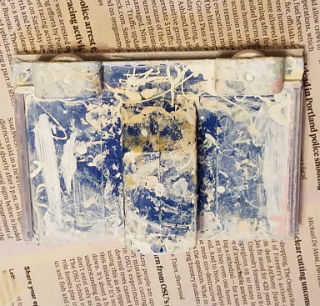
Before I moved on to painting the dining room, I needed to finish some moldings that I planned to use for the purpose of dividing the room into two colors horizontally. I put the moldings on a big table on the patio, with newspaper protecting the table. I needed something to keep the moldings from sticking to the newspaper while they were wet. My husband gave me some pieces of thick welding wire, to place one under the rows of molding every foot or two, perpendicular to the moldings. You could roll the wire while the moldings were drying to make sure the moldings didn’t stick to the wire. I later decided something thicker would be better, because the moldings would bend slightly in some places and could easily make contact with the newspaper. I asked my husband to cut the bottom bars out of some cheap plastic hangers to use instead. They worked quite well. I realized later that dowel rods would work well, or even round plant stakes might work for some things. You could use some sort of round sticks under doors that you are painting on a flat surface, by placing the sticks diagonally under two opposite corners.
TIP #3 – Have some sort of round sticks available if you plan to paint something on top of a flat surface to which it may stick.
When it was time to paint the dining room, I was not going to go through the torture I went through in the kitchen using a regular tall ladder that was so awkward to move around. I bought an awesome ladder with three large steps and a shelf for paint cans or roller trays at the top. There was a bar above the top step to provide the user with stability. I put a long handle on the roller to do the ceiling, so I didn’t even have to climb up and down the ladder for that part.
The next day it was time to do the walls. I couldn’t wait to use my new ladder! First I needed to do that little line where the wall meets the ceiling. I don’t really have a gift for painting straight lines along the ceiling, but I have found a handy-dandy little paint pad that has rollers on one edge to glide along the ceiling. It’s a great little tool that can also be used around door and window moldings, in some cases. After you glide it along the ceiling or around the window molding or wherever you’re using it, blot the paint with it so that it gives the same texture you will get with the roller. Then it will all blend together.
TIP #4 – Buy an edging tool to paint around the ceilings.
By the time I was ready to paint the wall around the edges of the ceiling that next day, it was already late in the day. I discovered that my little handy-dandy paint pad with rollers had accumulated some dried paint along the edges. It had been used quite a few times. I didn’t know I could have bought refill pads to slide onto it. By the time I discovered that this little tool was no longer working well, I was not about to make yet another trip to the home improvement store to buy another one. I decided to paint around the edge by hand. I didn’t get as close to the ceiling as I should have, so I always hope that our guests don’t look up. Hopefully, the wall décor will distract them. That experience taught me that you should always get all your supplies together and make sure you have all the equipment you’ll need in good condition before you start. (See the checklist provided at the end of this article for your convenience.)
TIP #5 – Make sure you have all the equipment and supplies you need before you begin your job.
(see checklist download at end of article)
Finally it was time to paint the bathroom. It’s small, but very challenging. The back of the bathtub has a slope, and there is a little shelf behind it. Even my beloved new three-step ladder was not up to the challenge. I wouldn’t be able to reach all the corners of the room. I found a ladder online with four big steps, rails on the sides, and a bar at the top that extended much higher than the one on the other ladder. I could climb to the third step, with such a high stability bar, and I could put my paint on the fourth step. We would have to put plywood in the bottom of our fiberglass bathtub, so as not to punch holes in it with the legs of the ladder. We put a blanket under the plywood to avoid scratching the tub. We had to remove the toilet in order to get the ladder in the right position to reach the area over the back of the tub.
TIP #6 – Be certain you have a ladder that is tall enough and safe enough to meet your needs when painting high or hard-to-reach places.
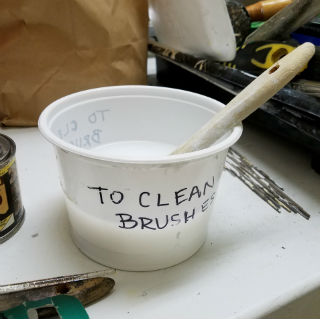
The new medicine cabinet we bought didn’t quite fit in the hole made for the old one. So we had to mess up the fresh paint above the sink when we adjusted the size of the hole. Out came the blue paint can again. Then it was time to clean the blue paint out of the brush one more time. I learned that having a little container all prepared with soapy water is handy to soak your brush in as soon as you are done with it. Something like a plastic cottage cheese container, filled with lukewarm water with just a bit of dish soap swished in, works well. (This is assuming you are using water-based paint so that it is appropriate to clean your brush with soapy water.) Since I have been cleaning my little brush immediately when I’m done with it, I have been able to use the same inexpensive brush over and over.
TIP #7 – Have a little container with soapy water ready to soak your brush in as soon as you are done with it.
Then it was time to paint the hallway. I had already washed down the walls with trisodium phosphate, usually called “TSP,” since the walls had been painted with semi-gloss. Then of course they have to be rinsed with clean water. A mild detergent is usually recommended for less glossy paints. My husband put patching cement over all the nail holes and little dents. I had learned the hard way some years earlier that if you don’t paint primer over the patching cement, the new paint won’t take well where you applied the cement. The new paint will soak into the cement, and those spots will look different from the rest of the wall.
TIP # 8 – Paint over the patching cement on nail holes and dents with primer.
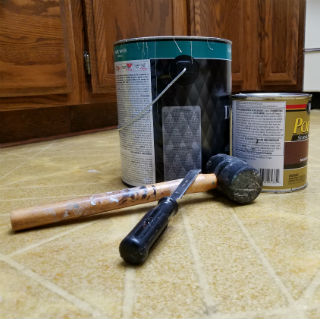
Before I could paint the walls, I needed to stain the doors and moldings darker to match the other part of the house we had remodeled years earlier. The difference had always bothered me. Since these doors and moldings already had a polyurethane finish on them, they wouldn’t accept stain unless we sanded them down to the wood. We didn’t want to do that, so we would have to paint them with polyurethane that has stain right in it, sometimes called “one-step.” I would just sand them lightly to make sure the new polyurethane finish would adhere well. None of the colors available appeared to match our other woodwork, so I would have to use one coat of one color and one of another, as we had done before. However, just when I was ready to start the work, I opened both cans and discovered the contents of one was as hard as a rock. That was another lesson for me.
TIP #9 – If you plan to use a product you have had for quite a while, check to make sure it hasn’t degraded over time.
This dried out stain/polyurethane was the beginning of a big “headache.” It turned out that we were unable to get a new can of the product in the same color. I bought another brand of the product with a similarly named color, thinking it would be very much the same. The first brand had been very fluid and the stain translucent. I painted one door with the second brand. It went on like glue, and the stain was so opaque that I thought I might as well have just painted it. Information I found online gave me permission to thin it, so I added a bit of water. When I applied it to another door, it actually seemed worse. To my dismay, I discovered it was oil-based rather than water-based, which meant it should have been thinned with mineral spirits. (That’s what you also use to clean your brushes when using oil-based products.)
The customer service guy at the company that made the stain/polyurethane product said they don’t recommend thinning it all, and the guy at the home improvement store feared that having thinned an oil-based product with water might degrade its adherence to the door over time. We ended up sanding the door down to the wood and getting a shade of the original brand that seemed it would work, and it did. But before I tried the new color, I finally got smart, which leads me to the next tip.
TIP #10 – Before applying a stain product to your project, always take a piece of wood similar to the wood you are finishing and test the product to make sure it’s going to give you the result you want.
Truth be told, I’ve always hated applying polyurethane products. First of all, it has bad fumes, although newer products have been improved in that respect. You have to be sure you have plenty of ventilation. I opened the windows and turned on a fan. If you’re sensitive to the fumes, you may need to wear a mask. Secondly, it’s messy. It’s more difficult applying it vertically than horizontally. I have witnessed an anomaly while applying polyurethane. Instead of dripping straight down from the brush, it drips close to the edge of the newspaper, putting the carpet in grave jeopardy. If Isaac Newton were still around, I might ask him how polyurethane drips defy the law of gravity. On top of that, it was running down my hand and making its way down to my elbow. Then I realized I had forgotten something important.
TIP #11 – When applying a polyurethane product, don’t forget to wear latex gloves, or comparable disposable gloves.
I was glad I had some hand cleaner. I use a brand called “Goop,” but I’m sure there must be others out there. Oil-based products are very difficult to clean off with soap and water. It’s good to have hand cleaner available even if you remember to wear gloves. You may find a drip on your forearm an hour or two later.
TIP #12 – Have some hand cleaner available if you are using oil-based products.
When I was finally done refinishing the woodwork in the hallway, I was able to move on to painting the walls. When I went to open the can of paint, which I had partially used for part of the dining room, I worked and worked with my paint can opener and my awl. Neither worked. My husband finally pried off the lid with a pair of pliers. Having too much dried paint in the ridges of the opening of the can may make it nearly impossible to pry the can open. (Some brands have plastic containers, but it seems the majority of containers are metal cans.) Here is another important suggestion I need to give you.
TIP #13 – Before you put the lid back on your paint, wipe off the paint in the ridges on the edges of the can. If you are frequently pouring or dipping more paint out of the can, temporarily put some cellophane or foil on the can while you’re using it, to keep the paint on the edges from drying.
I used painters’ tape to protect some parts of the woodwork after it was cured enough so that tape wouldn’t damage the newly finished woodwork. Before I forget, I must tell you a lesson I learned about painters’ tape quite a few years earlier.
TIP #14 – Always remove the painters’ tape while the paint is still very wet. Otherwise, you may rip some of the paint off with it when you remove it.
While you’re painting or applying finish, you’re bound to need a break to get something to eat, to make a phone call, or to use the bathroom. You don’t need to clean your brush or roller. Here’s another tip.
TIP #15 – When taking a break, just wrap your brush or roller tightly in cellophane or put it in a plastic bag with all the air forced out.
After I was done painting the hallway, when I looked at it from the side the texture seemed varied in some places. I applied a second coat, but with much the same result. I don’t think anyone will notice once the pictures are on the walls, but it made me research the best technique for application of paint with a roller. Not all recommendations were the same. One recommendation was to roll it on diagonally and then up and down, which is what I had done. One web site told how the professionals do it, so that is what I will recommend.
TIP #16 – When applying paint to a wall using a large roller, make a big “W” about 3’ by 3’ on one section of the wall, then go over the section with an up and down motion.
TO HELP YOU FURTHER, I HAVE MADE A CHECKLIST that should include most everything you might need for your painting or finishing project. See below to download it.
If you have a project in mind, I hope my story hasn’t discouraged you. If you have extra money in your budget and don’t have much time or patience, you might decide to hire someone to do the work. If you don’t have extra money or don’t want to spend it, you can probably manage to do it yourself if you don’t have any physical problems that would prevent it. Hopefully, you will be very pleased with what you’ve accomplished when you’re done.
Happy renovating!


Leave A Comment