

 I think my favorite Christmas carol is “O, Holy Night.” I am also fond of “I Heard the Bells on Christmas Day,” which is a less familiar carol. Both were important in times of conflict. I thought it would be valuable to discuss a little about their origins. You can often learn some very unexpected things by researching the history of a hymn or carol.
According to Belief Net, the story of “O, Holy Night” began in France in 1847 when a priest asked Placide Cappeau de Roquemaure, a “commissionaire of wines” known for his poetry, to write a poem for Christmas mass. Greatly moved by his own poem, the poet imposed on a Jewish friend well known for his music, Adolph Charles Adams, to set it to music. Though it quickly rose to popularity after Midnight Mass, later the French Catholic church tried in vain to snuff it out. They had learned that the author of the lyrics had turned his back on the church and had instead become a socialist and that the writer of the music was Jewish and therefore wouldn’t accept Christ as the Messiah.
Ten years later an American writer, John Sullivan Dwight, became convinced that this song should be translated for the American people. Being an abolitionist, he was particularly moved by the words of the third verse that included words translated as “Chains shall He break, for the slave is our brother.”
“O, Holy Night” became especially popular during the Civil War.
A legend states that on Christmas Eve of 1871, during a harsh battle between German and French soldiers in the Franco-Prussian War, a member of the French army leaped out of a muddy trench and began singing the French version of “O, Holy Night.” The legend goes on to say that a German soldier then revealed himself and began singing “From Heaven Above to Earth I Came” by Martin Luther. According to the legend, a 24-hour truce followed.
Thomas Edison’s chief chemist, Reginald Fessenden, made the very first radio broadcast over the airwaves on Christmas Eve of 1906. Those operating radios on ships and at newspapers were stunned to hear something different coming through their radios. Fessenden began by reading the gospel of Luke. Then he picked up his violin and played “O, Holy Night.” That concluded the first radio broadcast.
The New England Historical website reveals the moving story of “I Heard the Bells on Christmas Day.” It began with a poem written by Henry Wadsworth Longfellow on Christmas Day in 1863. In 1861 Longfellow had been overcome by depression after suffering burns while trying to smother the flames that killed his wife of 18 happy years. A flame had jumped onto her clothing while she was sealing an envelope with hot wax. The words of Christmas Day 1862 written in his journal show he was still in deep mourning.
Yet another tragedy overtook Longfellow in 1863. Despite Longfellow’s strong abolitionist views, his son Charley went off to fight in the Civil War. On December 8th, he brought his son home for a long journey of nursing him back to health after a bullet nicked his spine. But on Christmas Day, when Longfellow heard the bells of Christmas, they suddenly spoke a message of peace to him. Then came the profound five stanzas to his poem he called “Christmas Bells,” now known as the Christmas carol entitled
“I Heard the Bells on Christmas Day.” It was set to music in 1872.
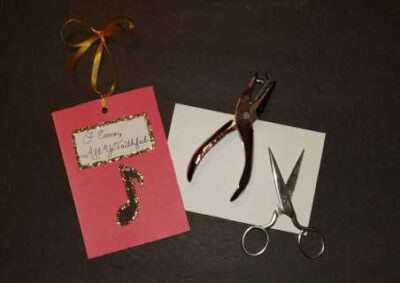
For me—and I think lots of people—one of the best parts of Christmas is the beautiful traditional carols we enjoy at this time of year. So why not bring the beautiful essence brought to mind by their titles to your Christmas tree? Here I’m providing instructions and patterns to make it happen. If you have no way to get access to a printer or prefer to do it yourself, you could make your own carol titles on white pieces of paper 1-1/2” high by 3” wide and a musical eighth note pattern 2-1/4” high by 1” wide. Then follow the guidance of the instructions.
If the project sounds a little tedious, put on some Christmas music or a favorite movie you’ve seen a hundred times before. I’ve made a list of everything you need to make these ornaments, so you can get it all together and be ready to go.






Leave A Comment